A4 vs A3 vs A5 DTF Printing: Understanding Print Sizes & Costs
DTF printing has become one of the most popular methods for customizing T-shirts, hoodies, jerseys, uniforms, and other apparel. It allows businesses to print detailed, colourful designs without requiring large production quantities.
A4 vs A3 vs A5 DTF Printing: Understanding Print Sizes & Costs
DTF printing has become one of the most popular methods for customizing T-shirts, hoodies, jerseys, uniforms, and other apparel. It allows businesses to print detailed, colourful designs without requiring large production quantities.
However, one common question customers have is:
Should I choose A5, A4, or A3 DTF printing?
The right print size can affect the appearance of your design, the amount of printing material used, and the overall printing cost.
In this guide, we'll explain the difference between A5, A4, and A3 DTF printing, where each size works best, and how to choose the right option for your apparel.
What Is DTF Printing?
DTF stands for Direct-to-Film printing.
In this printing process, the design is printed onto a special PET film using DTF inks. Powder adhesive is then applied to the printed design. After curing, the design can be transferred onto the garment using a heat press.
DTF printing is suitable for many types of apparel, including:
Cotton T-shirts Polyester T-shirts Cotton-blend garments Hoodies Sports jerseys Tote bags Uniforms Custom merchandise
One of the biggest advantages of DTF printing is that it can reproduce detailed designs, multiple colours, gradients, and complex artwork.
What Are A5, A4 and A3 DTF Print Sizes?
A5, A4, and A3 refer to commonly used print-size formats.
The approximate dimensions are:
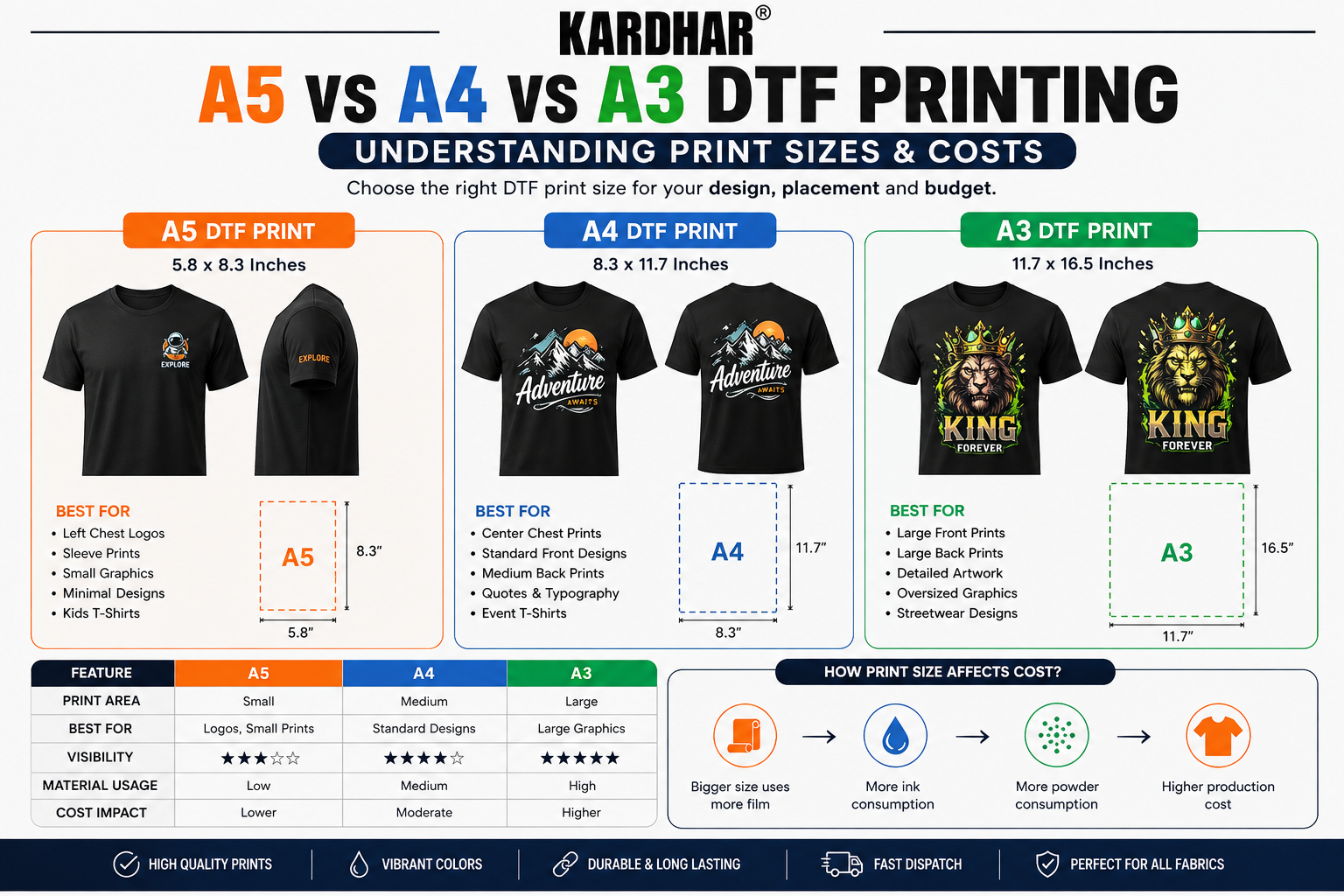
Print Size Approximate Dimensions Common Use A5 5.8 × 8.3 inches Small logos and chest prints A4 8.3 × 11.7 inches Standard front and back designs A3 11.7 × 16.5 inches Large front and back graphics
Actual usable printing dimensions may vary depending on the printer, artwork, supplier, and required margins.
A5 DTF Printing
A5 is a smaller print format and is ideal when you want the design to remain relatively compact.
It is commonly used for small branding and minimal designs.
A5 DTF is suitable for: Left chest logos Small front graphics Sleeve branding Brand logos Minimal typography Small merchandise designs Kids' apparel
For example, if a clothing brand wants to place a small logo on the left chest of a T-shirt, an A5-sized print may be sufficient.
Advantages of A5 Printing Suitable for small designs Lower material usage Clean and minimal appearance Great for logos and branding Useful for small print placements
Best for: Small logos, chest prints, sleeves, and minimalist designs.
A4 DTF Printing
A4 is one of the most commonly used print sizes for custom apparel.
It provides more space than A5 while remaining suitable for most standard T-shirts.
A4 printing can be used for both front and back designs depending on the artwork and garment.
A4 DTF is suitable for: Centre chest designs Standard front graphics Medium-sized back prints Quotes Typography Brand graphics Event T-shirts Custom merchandise
If you're unsure which size to choose for a standard T-shirt design, A4 is often a practical starting point.
Advantages of A4 Printing Good balance between size and cost Suitable for many T-shirt designs Works well for typography and graphics Large enough for noticeable artwork Suitable for front and back printing
Best for: Standard T-shirt graphics and medium-sized designs.
A3 DTF Printing
A3 is a larger print format designed for artwork that requires more space.
It is especially useful for large graphics and designs intended to become the main visual element of a T-shirt.
A3 DTF is suitable for: Large front prints Large back prints Oversized T-shirts Streetwear graphics Detailed illustrations Promotional T-shirts Large typography Statement designs
A3 can be particularly useful for oversized T-shirts because the larger garment provides more visual space for the artwork.
Advantages of A3 Printing Large print area Suitable for detailed artwork Strong visual impact Great for streetwear Suitable for large front and back graphics
Best for: Large artwork, oversized T-shirts, streetwear, and statement graphics.
A5 vs A4 vs A3 DTF Printing
Here's a simple comparison:
Feature A5 A4 A3 Print Area Small Medium Large Small Logo Excellent Good Not usually required Chest Print Excellent Excellent Good Standard Front Print Limited Excellent Very Good Large Back Print Limited Good Excellent Oversized T-Shirt Limited Good Excellent Material Usage Lower Medium Higher Best For Logos Standard designs Large graphics How Does DTF Print Size Affect Cost?
Print size can influence DTF printing costs because a larger design generally requires more film and ink.
In simple terms:
A5 → A4 → A3
As the print area increases, material consumption can also increase.
However, DTF pricing isn't always calculated by simply charging a fixed amount for every A5, A4, or A3 print.
The final cost may depend on factors such as:
Total film area used Number of designs Ink coverage White ink consumption Artwork arrangement Quantity ordered Gang-sheet utilization Printing and finishing requirements
This is why two designs with the same dimensions can sometimes have different production costs.
What Is a DTF Gang Sheet?
A DTF gang sheet allows multiple designs to be arranged together on one larger sheet of film.
Instead of printing each design separately, several designs can be placed efficiently on the same sheet.
For example, a gang sheet could contain:
Multiple logos + A5 graphics + A4 designs + sleeve prints
This can help reduce unused space and improve material utilization.
Gang sheets are especially useful for:
Clothing brands T-shirt resellers Small businesses Bulk orders Multiple-design collections Custom merchandise
The more efficiently your artwork is arranged, the better you can utilize the available printing area.
Which DTF Size Is Best for T-Shirts?
The best size depends on the design and its placement.
Choose A5 if:
You need a small logo, chest design, or sleeve print.
Choose A4 if:
You need a standard front or medium-sized back design.
Choose A3 if:
You want a large, bold graphic, especially on an oversized T-shirt.
There is no reason to use A3 for every design. A larger print isn't automatically a better print.
The artwork should be proportional to the garment.
What DTF Size Is Best for Oversized T-Shirts?
Oversized T-shirts have a larger overall surface area than regular-fit T-shirts.
Because of this, a small A5 design can sometimes look too small on an oversized garment.
For large streetwear graphics, A3 or another larger custom print size may create a better visual balance.
Popular oversized T-shirt combinations include:
Large front print Large back print Small front + large back Front + back graphics Large typography Detailed illustrations
However, the final size should always be checked against the actual garment dimensions.
A Common Mistake: Choosing the Largest Print Size
Many people assume that a larger print automatically looks better.
That's not always true.
A small logo printed at A3 size may look unprofessional, while a detailed artwork printed too small may lose its visual impact.
Instead of choosing the largest available size, consider:
Design → Placement → Garment → Print Size
This approach helps create a more balanced final product.
How to Choose the Right DTF Print Size
Follow these simple steps before sending your design for printing.
Step 1: Choose Your Garment
First determine whether you're printing on:
Regular T-shirt Oversized T-shirt Polo Hoodie Sports jersey Tote bag
Different garments have different printable areas.
Step 2: Decide the Placement
Choose where the artwork will be printed.
Common placements include:
Left chest Centre chest Full front Upper back Full back Sleeve Step 3: Check Your Artwork
Look at the design itself.
Is it:
A small logo? Typography? A detailed illustration? A photograph? A large graphic?
The artwork should determine the required print area.
Step 4: Select the Print Size
As a general guide:
Small logo → A5
Standard graphic → A4
Large graphic → A3
Step 5: Check a Mockup
Before production, place the design on a T-shirt mockup.
This helps you check whether the design looks too small, too large, too high, or too low.
A5, A4 or A3: Which One Should Resellers Choose?
For T-shirt resellers, offering different print sizes can be useful because customers have different requirements.
For example:
Logo: A5
Front artwork: A4
Large back artwork: A3
This allows you to provide different customization options without forcing every customer to use the same print size.
For bulk orders, gang-sheet optimization can also help utilize printing material more efficiently.
DTF Print Size for Different Applications Application Recommended Size Small Chest Logo A5 Sleeve Logo A5 Centre Chest Graphic A4 Standard Front Design A4 Medium Back Design A4 Large Back Graphic A3 Oversized Streetwear Design A3 Large Front Artwork A3 Small Brand Logo A5
These are general recommendations. The final size should always be determined by the artwork and garment.
Final Thoughts
A5, A4, and A3 DTF printing are designed for different applications.
A5 is ideal for small logos, chest prints, and sleeve branding.
A4 is a versatile option for standard front and back graphics.
A3 is better suited for large artwork, oversized T-shirts, streetwear designs, and statement graphics.
The most important thing is not to choose the biggest print size available. Instead, choose a size that matches your design, garment, placement, and budget.
A well-proportioned print will always look more professional than a design that is simply made as large as possible.