Best T-Shirt Fabric for DTF, Screen Print, Puff & Embroidery
Choosing the right T-shirt fabric is just as important as choosing the right printing or customization method. A great design can look completely different depending on the fabric, GSM, texture, and finish of the T-shirt.
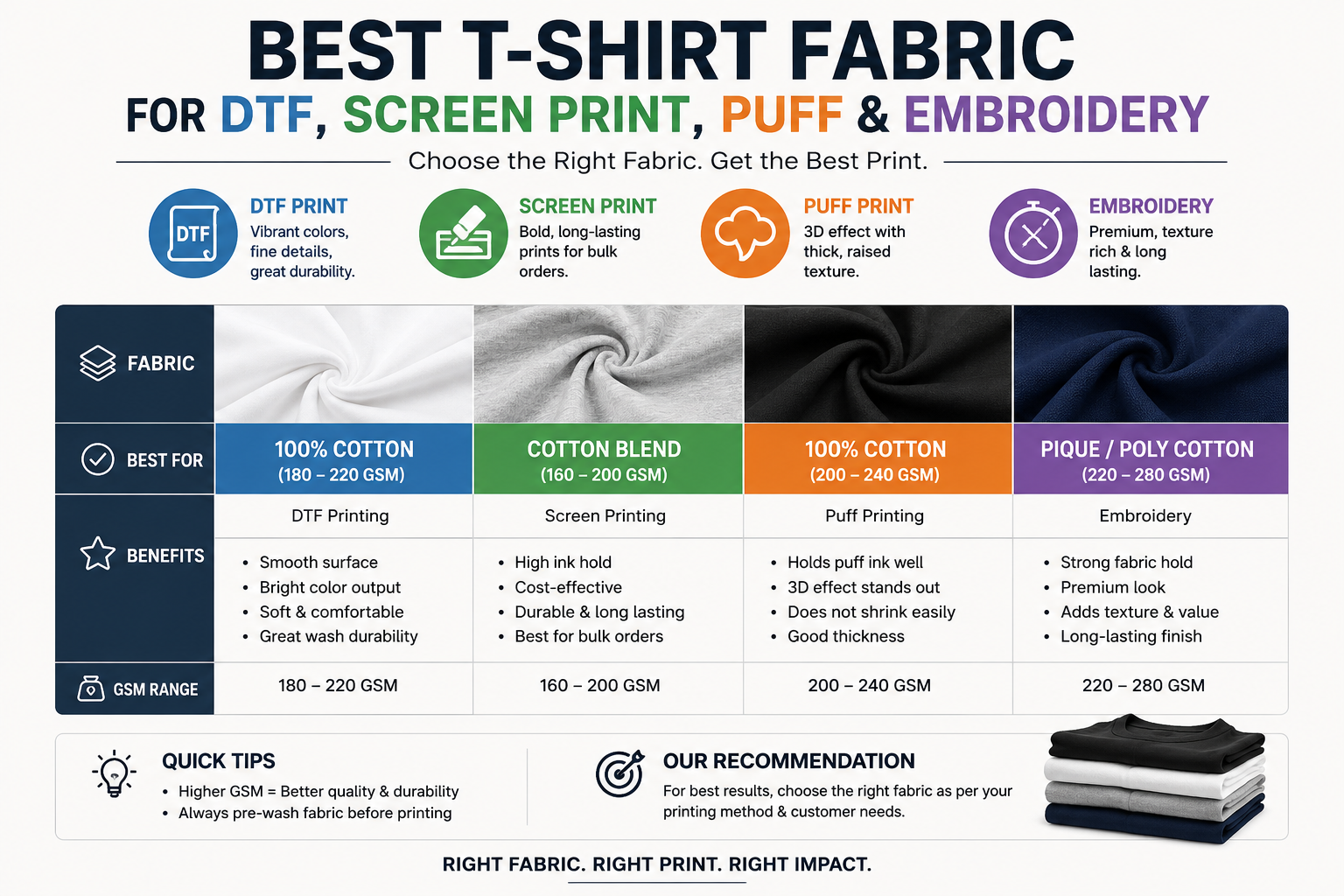
Best T-Shirt Fabric for DTF, Screen Print, Puff & Embroidery
Choosing the right T-shirt fabric is just as important as choosing the right printing or customization method. A great design can look completely different depending on the fabric, GSM, texture, and finish of the T-shirt.
Whether you are a **clothing brand, reseller, startup, corporate buyer, sports business, or POD seller**, selecting the right fabric can help you achieve better print quality, durability, comfort, and overall product appearance.
In this guide, we will explain the **best T-shirt fabrics for DTF printing, screen printing, puff printing, and embroidery** and help you choose the right option for your business.
---
Why T-Shirt Fabric Matters for Printing
Different fabrics react differently to heat, ink, pressure, and embroidery needles.
The right fabric can provide:
- Better print adhesion
- Sharper colors
- Longer-lasting prints
- Better embroidery finish
- Improved comfort
- Premium appearance
- Better durability after washing
Before selecting a printing technique, always consider the **fabric composition and GSM** of the T-shirt.
---
1. Best Fabric for DTF Printing
Recommended: 100% Cotton & Cotton Blend
**DTF (Direct-to-Film) printing** is one of the most versatile T-shirt printing methods because it can work on a wide range of fabrics.
However, for premium results, **100% cotton and good-quality cotton blends** are excellent choices.
100% Cotton
100% cotton T-shirts are a popular choice for DTF because they provide a comfortable surface and a premium overall feel.
**Best for:**
- Custom T-shirts
- Clothing brands
- Streetwear
- Merchandise
- Reseller products
- Personalized apparel
Cotton Blend
Cotton-blend T-shirts can also work well with DTF printing and are often selected when buyers want a balance between **cost, durability, and comfort**.
Best GSM for DTF
For general custom T-shirts:
- **160–180 GSM:** Lightweight and economical
- **180–220 GSM:** Premium everyday wear
- **220–240 GSM:** Heavyweight and premium streetwear
For most clothing brands, **180–240 GSM** provides an excellent balance between fabric quality and print appearance.
---
2. Best Fabric for Screen Printing
Recommended: 100% Cotton
Screen printing is one of the most traditional and reliable T-shirt printing methods.
For high-quality screen printing, **100% cotton fabric** is generally one of the best choices, especially for cotton-based garments.
Cotton provides a good surface for screen-printing inks and is widely used for:
- Brand merchandise
- Event T-shirts
- Promotional T-shirts
- College merchandise
- Uniforms
- Bulk orders
Why Cotton Works Well for Screen Printing
Cotton offers:
- Good ink absorption
- Smooth printing surface
- Strong print durability
- Comfortable feel
- Excellent results for bulk production
For large orders with simple or limited-color artwork, screen printing can be a cost-effective solution.
---
3. Best Fabric for Puff Printing
Recommended: Cotton & Heavyweight Cotton
Puff printing creates a **raised, 3D effect** on the T-shirt.
Because puff printing is designed to create a dimensional finish, fabric selection becomes particularly important.
**Heavyweight cotton T-shirts** are an excellent choice for puff printing because the fabric can provide better structure and support for the raised print.
Ideal GSM for Puff Printing
For premium puff designs, consider:
- **200 GSM**
- **220 GSM**
- **240 GSM**
- **Higher GSM heavyweight fabrics**
Heavyweight T-shirts are especially popular for modern streetwear and oversized clothing.
Best Uses for Puff Printing
- Streetwear brands
- Oversized T-shirts
- Logo T-shirts
- Fashion collections
- Premium merchandise
A heavier T-shirt combined with puff printing can create a premium, high-end appearance.
---
4. Best Fabric for Embroidery
Recommended: Thick Cotton, Pique & Structured Fabrics
Embroidery is different from printing because the design is stitched directly into the fabric.
For embroidery, the fabric should have enough **strength and structure** to support the stitches.
Excellent options include:
- Cotton
- Pique cotton
- Heavyweight cotton
- Cotton-polyester blends
- Structured polo fabrics
- Fleece and sweatshirt fabrics
Embroidery on Polo T-Shirts
Polo T-shirts are particularly suitable for embroidery because their structured fabric provides a professional base for logos.
This makes embroidered polos popular for:
- Corporate uniforms
- Company staff
- Restaurants
- Hotels
- Schools
- Sports clubs
- Promotional clothing
---
DTF vs Screen Print vs Puff vs Embroidery
| Printing Method | Recommended Fabric | Ideal Use | | ---------------- | -------------------------------- | ---------------------------------- | | **DTF** | 100% Cotton, Cotton Blend | Custom designs & detailed graphics | | **Screen Print** | 100% Cotton | Bulk orders & simple designs | | **Puff Print** | Heavyweight Cotton | 3D & streetwear designs | | **Embroidery** | Cotton, Pique, Structured Fabric | Logos & premium branding |
---
Best Fabric by T-Shirt Type
Regular T-Shirts
For regular-fit T-shirts, **160–180 GSM cotton or cotton blend** can be a practical choice for everyday products.
They work well for:
- DTF
- Screen printing
- Basic branding
- Promotional T-shirts
Oversized T-Shirts
For oversized and streetwear T-shirts, **220–240 GSM cotton** is a popular premium option.
These fabrics are suitable for:
- DTF
- Puff printing
- Screen printing
- Streetwear designs
Polo T-Shirts
For polos, **pique and structured cotton fabrics** are excellent choices.
They are ideal for:
- Embroidery
- Screen printing
- Corporate branding
- Uniforms
Hoodies
For hoodies, **280–350 GSM fabrics** can provide a premium heavyweight feel.
They are commonly used for:
- Puff printing
- DTF
- Embroidery
- Streetwear branding
---
100% Cotton vs Cotton Blend for Printing
Both fabrics can be useful, but they serve different purposes.
100% Cotton
**Advantages:**
- Premium natural feel
- Excellent comfort
- Great for screen printing
- Suitable for DTF
- Popular for fashion brands
Cotton Blend
**Advantages:**
- Cost-effective
- Good durability
- Easy-care properties
- Suitable for many custom printing applications
- Good option for bulk and reseller orders
The best choice depends on your **budget, product positioning, printing method, and target customer**.
---
What GSM Should You Choose?
GSM stands for **Grams per Square Meter** and indicates the weight of the fabric.
Generally:
160–180 GSM
Best for lightweight and everyday T-shirts.
180–220 GSM
Good for premium everyday wear and custom clothing.
220–240 GSM
Ideal for heavyweight and oversized T-shirts.
280–350 GSM
Suitable for premium hoodies and heavyweight apparel.
Remember that GSM alone doesn't determine quality. **Fabric composition, knitting quality, finishing, stitching, and construction** also matter.
---
How to Choose the Right Fabric for Your Business
If you're starting a clothing brand or buying T-shirts in bulk, consider these factors:
1. Printing Method
First decide whether you're using DTF, screen printing, puff, or embroidery.
2. Design Type
Detailed designs generally work well with DTF, while simple bulk designs can be suitable for screen printing.
3. Product Positioning
For premium streetwear, consider heavyweight fabrics.
For promotional products, lightweight and economical fabrics may be more suitable.
4. Quantity
For large bulk orders, screen printing can be a practical option for suitable designs.
For smaller customized orders, DTF provides flexibility.
5. Target Customer
Always choose fabric based on what your customers expect in terms of comfort, appearance, durability, and price.
---
Final Verdict: Which Fabric Is Best?
There is no single fabric that is perfect for every printing technique.
For **DTF printing**, 100% cotton and quality cotton blends are excellent choices.
For **screen printing**, 100% cotton is a reliable option, particularly for bulk production.
For **puff printing**, heavyweight cotton around 200–240 GSM can provide a strong premium base.
For **embroidery**, structured fabrics such as cotton, pique, and heavyweight materials are ideal.
Quick Recommendation
**DTF → 100% Cotton / Cotton Blend**
**Screen Print → 100% Cotton**
**Puff Print → 200–240 GSM Heavyweight Cotton**
**Embroidery → Cotton / Pique / Structured Fabric**
---
Looking for Custom T-Shirts in Bulk?
Choosing the right fabric is only the first step. Your final product also depends on **printing quality, stitching, finishing, sizing, and manufacturing consistency**.
At **KARDHAR**, we provide customized T-shirt manufacturing and printing solutions for **resellers, clothing brands, startups, and bulk buyers**.
Whether you need **DTF printing, screen printing, puff printing, embroidery, regular-fit T-shirts, oversized T-shirts, polos, hoodies, or sportswear**, selecting the right combination of fabric and printing method can help you create a better product.
**Choose the right fabric. Choose the right printing method. Build a better T-shirt brand.**