How to Choose the Right T-Shirt Size Chart for Your Clothing Brand
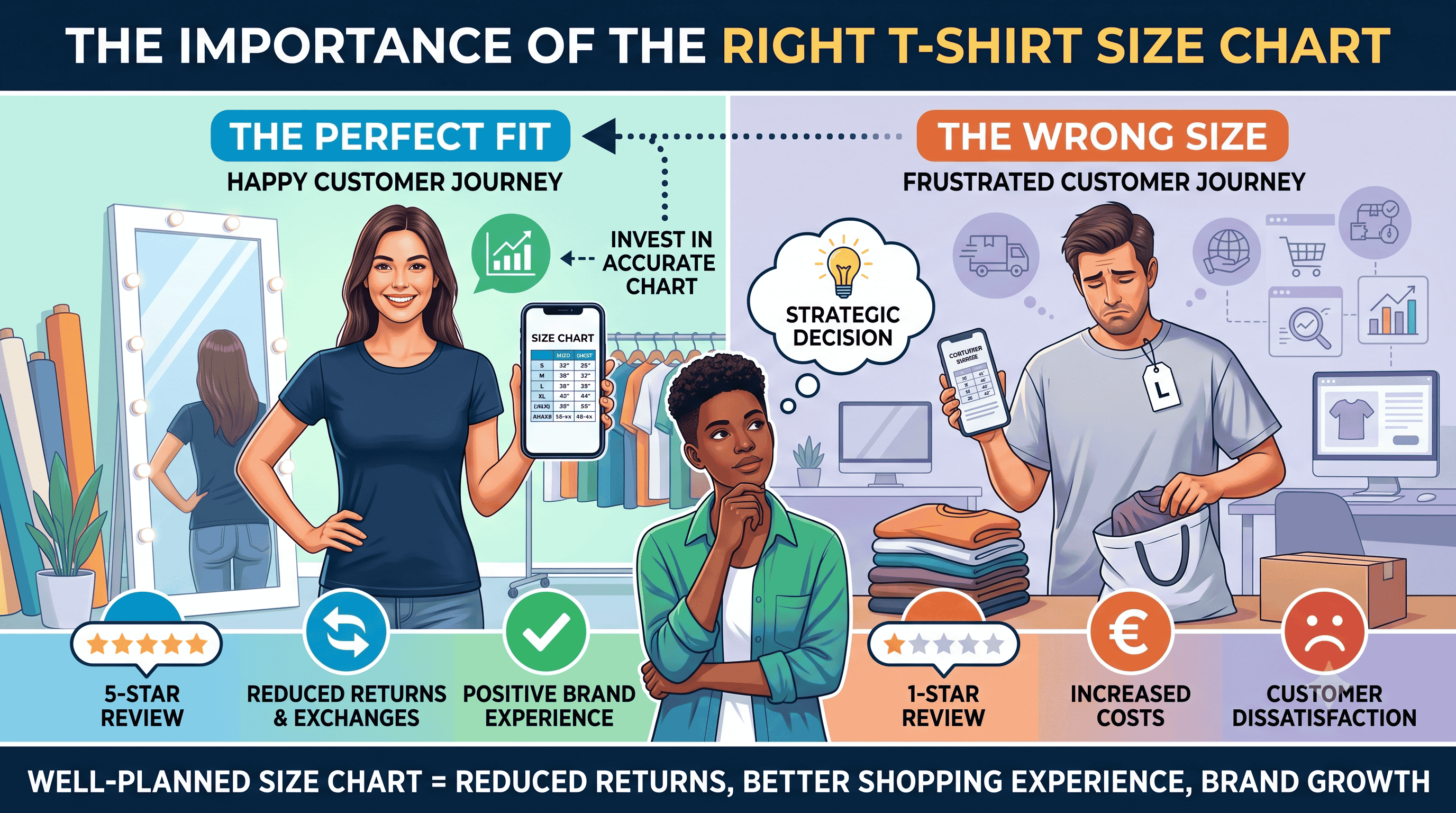
Choosing the right T-shirt size chart is one of the most important decisions for any clothing brand. A well-planned size chart helps customers select the correct size, reduces exchanges and returns, and creates a better overall shopping experience.
How to Choose the Right T-Shirt Size Chart for Your Clothing Brand
Choosing the right T-shirt size chart is one of the most important decisions for any clothing brand. A well-planned size chart helps customers select the correct size, reduces exchanges and returns, and creates a better overall shopping experience.
Whether you are starting a new clothing brand, selling oversized T-shirts, or ordering custom T-shirts in bulk, your size chart should match your actual garment measurements—not just standard industry sizes.
In this guide, we’ll explain how to create and choose the right T-shirt size chart for your clothing brand.
Why Is a T-Shirt Size Chart Important?
Customers cannot physically try on a T-shirt when shopping online. They depend on your size chart to decide which size will fit them.
A clear size chart can help you:
- Reduce size-related returns and exchanges
- Improve customer confidence
- Make your brand look more professional
- Reduce confusion between different fits
- Maintain consistent sizing across products
- Improve customer satisfaction
For B2B clothing brands and resellers, consistent sizing is especially important because customers expect the same fit when they reorder.
Standard T-Shirt Sizes
Most T-shirt brands use sizes such as:
- XS
- S
- M
- L
- XL
- XXL
- 3XL
- 4XL
- 5XL
However, the actual measurements can vary between manufacturers and fits.
For example, a Medium in a regular-fit T-shirt may not have the same measurements as a Medium in an oversized T-shirt.
That's why you should never rely only on the letter size.
Regular Fit vs Oversized Fit
One of the biggest mistakes new clothing brands make is using the same size chart for every T-shirt style.
Regular Fit
Regular-fit T-shirts generally have a more traditional shape and are designed to follow the body's natural proportions.
Oversized Fit
Oversized T-shirts are intentionally wider and longer, with dropped shoulders and a relaxed silhouette.
Because of this, an oversized Medium may have a chest measurement similar to a regular-fit Large or XL.
**Tip:** Always create a separate size chart for different fits.
What Measurements Should Be Included?
A professional T-shirt size chart should include the most important garment measurements.
1. Chest Width
Measure the T-shirt flat from one armpit to the other.
This is one of the most useful measurements for customers because it helps them compare the T-shirt with one they already own.
2. Length
Measure from the highest point of the shoulder down to the bottom hem.
Length is especially important for oversized T-shirts and longline styles.
3. Shoulder Width
Measure from one shoulder seam to the other.
This measurement can help customers understand the overall fit and shoulder structure.
4. Sleeve Length
For products where sleeve fit matters, include sleeve length in the size chart.
This is particularly useful for oversized T-shirts, polo shirts, and long-sleeve garments.
Example Size Chart
A basic example could look like this:
| Size | Chest | Length | Shoulder | | ---- | ----: | -----: | -------: | | S | 19" | 27" | 17" | | M | 20" | 28" | 18" | | L | 21" | 29" | 19" | | XL | 22" | 30" | 20" | | XXL | 23" | 31" | 21" |
**Important:** These are example measurements only. Your final size chart should be based on the actual measurements of your garments.
Measure the Garment, Not Just the Person
For online clothing sales, garment measurements are often easier for customers to use.
Instead of asking customers to measure their body, you can tell them to take a T-shirt they already own and compare its measurements with your size chart.
For example:
**Step 1:** Take a T-shirt that fits you well. **Step 2:** Lay it flat on a table. **Step 3:** Measure from armpit to armpit. **Step 4:** Measure the total length. **Step 5:** Compare the measurements with your size chart.
This makes choosing the right size much easier.
Keep Your Measurements Consistent
Consistency is extremely important for a clothing brand.
If your Medium T-shirt measures 20 inches in one product and 23 inches in another product, customers may become confused.
Before publishing a size chart:
- Measure multiple pieces from the same production batch
- Check measurement tolerance
- Confirm measurements with your manufacturer
- Keep separate charts for different fits
- Update your chart if the pattern or fabric changes
Don't Copy Another Brand's Size Chart
Every manufacturer can have slightly different patterns, fits, and measurement standards.
Copying another brand's size chart can result in:
- Incorrect sizing
- Higher return rates
- Customer complaints
- Poor reviews
- Inconsistent product expectations
Instead, create your size chart using your own physical garments.
Add a Measurement Tolerance
Manufacturing garments are generally produced with a small measurement tolerance.
For example, if your size chart says the chest is 20 inches, an individual garment may have a small variation.
You can mention something like:
**"Measurement may vary by approximately 0.5–1 inch due to manufacturing and stitching tolerance."**
This helps set realistic expectations for customers.
Make Your Size Chart Easy to Understand
A complicated size chart can confuse customers.
Keep it simple and include:
- Size
- Chest
- Length
- Shoulder
- Sleeve, if necessary
- Measurement unit
- Fit information
You can also include a small visual diagram showing where each measurement is taken.
Mention the Model's Size
If you use models in your product photos, mention their size and basic information where appropriate.
For example:
**Model is wearing: L**
This gives customers an additional reference when choosing their size.
Consider Your Target Customer
Your size chart should also match your target market.
For example, a brand selling trendy oversized streetwear may need a different sizing strategy from a brand selling corporate uniform T-shirts.
Think about:
- Target age group
- Preferred fit
- Product category
- Market
- Fabric
- Style
- Customer expectations
Create Separate Charts for Different Products
Don't use one universal chart if your products have different fits.
You may need separate size charts for:
- Regular-fit T-shirts
- Oversized T-shirts
- Polo T-shirts
- Hoodies
- Sports jerseys
- Tank tops
- Women's T-shirts
Each product should have measurements that accurately represent its actual fit.
Size Chart for Resellers and B2B Buyers
If you are purchasing T-shirts in bulk, sizing becomes even more important.
Before placing a large order, ask the manufacturer for:
- Complete size chart
- Actual garment measurements
- Fabric details
- GSM
- Fit information
- Measurement tolerance
- Sample availability
If possible, order or check a sample before confirming large-scale production.
This can prevent expensive sizing problems later.
Common T-Shirt Sizing Mistakes
Mistake 1: Using One Chart for Every Fit
Regular and oversized T-shirts should not automatically use the same measurements.
Mistake 2: Showing Only S, M, L, XL
Letter sizes alone don't tell customers enough.
Always include actual measurements.
Mistake 3: Not Mentioning Measurement Method
Explain whether the measurement is taken flat, around the body, or from a specific seam.
Mistake 4: Ignoring Manufacturing Tolerance
Small variations can happen during production, so mention an acceptable tolerance.
Mistake 5: Not Updating the Chart
If your manufacturer changes the pattern, fabric, or fit, review your size chart again.
Final Checklist Before Publishing Your Size Chart
Before adding a size chart to your website, make sure:
☑ Actual garments have been measured ☑ Chest measurement is clearly explained ☑ Length is included ☑ Shoulder measurement is included when useful ☑ Different fits have separate charts ☑ Measurement units are clearly mentioned ☑ Manufacturing tolerance is explained ☑ Sample measurements have been verified ☑ The chart is easy to read on mobile ☑ Product photos mention the model's size when relevant
Conclusion
A good T-shirt size chart is more than a simple table of S, M, L, and XL. It should accurately represent your garment's measurements and fit.
For clothing brands, startups, resellers, and online sellers, a clear size chart can reduce confusion, improve customer confidence, and create a more professional shopping experience.
If you're sourcing T-shirts in bulk, always confirm the **actual garment measurements, fit, fabric, GSM, and size chart** with your manufacturer before placing a large order.
With the right sizing system, you can build a more consistent clothing brand and give your customers confidence when ordering online.