T-Shirt Printing Placement Guide: Chest, Back, Sleeve & Oversized Prints
Choosing the right print placement is just as important as choosing the right design. A well-designed T-shirt can look completely different depending on where the artwork is printed.
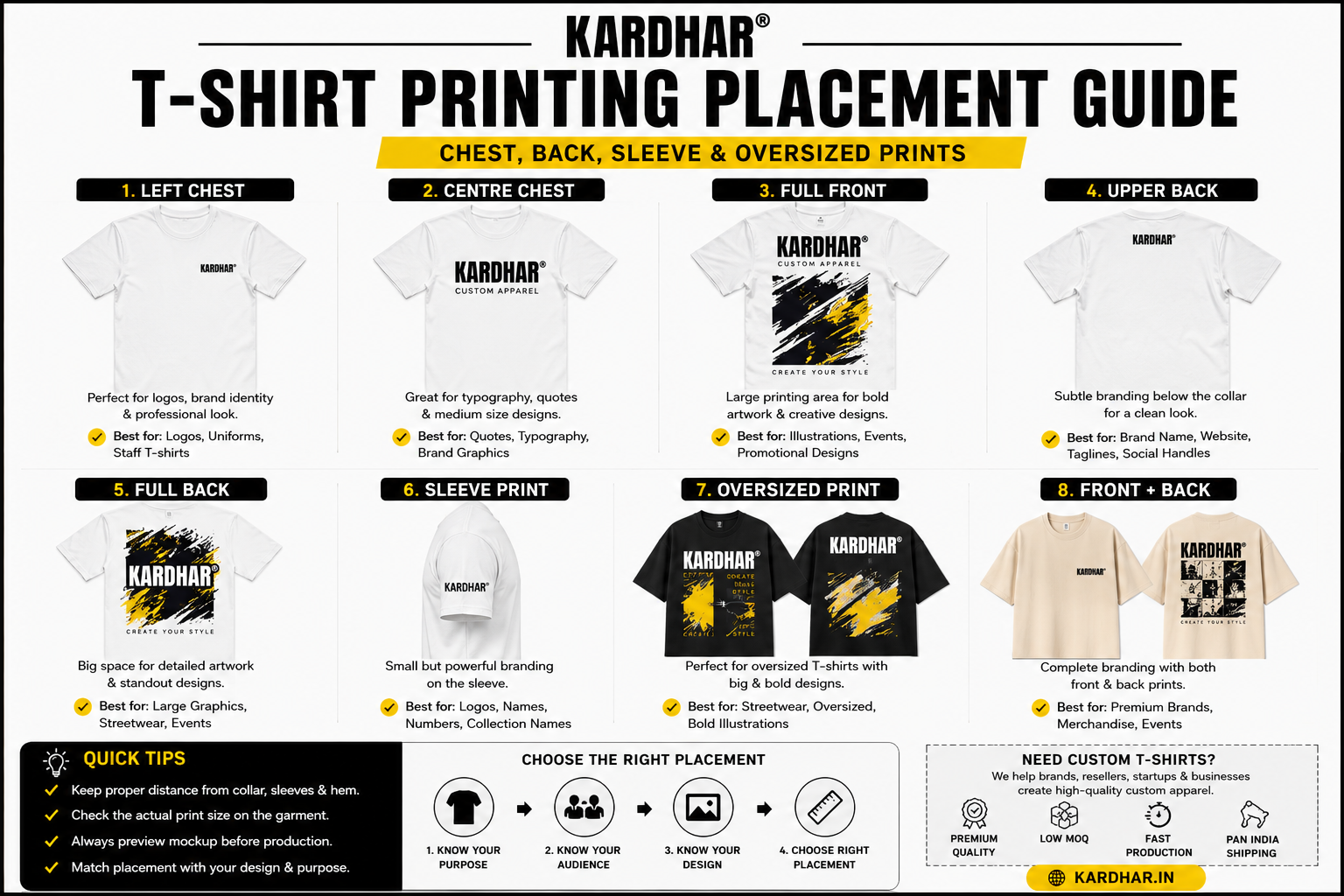
T-Shirt Printing Placement Guide: Chest, Back, Sleeve & Oversized Prints
Choosing the right print placement is just as important as choosing the right design. A well-designed T-shirt can look completely different depending on where the artwork is printed.
Whether you are creating T-shirts for a clothing brand, business, event, sports team, or resale business, understanding different printing placements can help you create better-looking apparel while avoiding unnecessary printing costs.
In this guide, we will explain the most popular T-shirt printing placements, their ideal uses, and how to choose the right placement for your design.
1. Left Chest Printing
Left chest printing is one of the most popular options for branding and professional apparel. It usually involves placing a small logo or design on the wearer's left chest.
It is commonly used for:
Company uniforms Brand logos Startup merchandise Staff T-shirts Corporate clothing Minimalist apparel
For small logos, a compact print size such as A5 or smaller may be suitable depending on the artwork.
The main advantage of left chest printing is that it creates a clean and professional appearance without making the T-shirt look crowded.
2. Centre Chest Printing
Centre chest printing places the artwork in the middle of the front of the T-shirt.
This placement works well for designs that need more visibility than a small chest logo but don't require a full-front print.
Centre chest printing is commonly used for:
Typography Quotes Brand graphics Small illustrations Event T-shirts Merchandise
It is particularly effective for simple designs with strong typography or a recognizable logo.
3. Full Front Printing
Full-front printing provides considerably more space for artwork and is ideal when the design is intended to become the main visual element of the T-shirt.
It is commonly used for:
Detailed illustrations Promotional designs Character artwork Large typography Streetwear graphics Creative merchandise
When creating a large front print, make sure there is enough space between the design and the collar, side seams, sleeves, and bottom hem.
The exact printable area can vary depending on the garment size and manufacturer.
4. Upper Back Printing
Upper-back printing is generally positioned below the collar and is a great option for subtle branding.
It can be used for:
Brand names Small logos Website addresses Social media handles Short taglines Collection names
A popular combination for clothing brands is a small front logo with an upper-back brand name.
This creates a simple and professional appearance.
5. Full Back Printing
The back of a T-shirt provides a large canvas for creative artwork, making it particularly popular for streetwear and graphic apparel.
Full-back printing works well for:
Large illustrations Brand campaigns Event designs Typography Promotional graphics Streetwear artwork
One popular clothing-brand layout is a small logo on the front combined with a large graphic on the back.
This creates a strong front-and-back design without making the front of the T-shirt too busy.
6. Sleeve Printing
Sleeve printing is a smaller branding option that can add an extra design element to a T-shirt.
It is commonly used for:
Small logos Brand names Initials Numbers Collection names Short text
Because sleeves have limited printable space, simple designs generally work better than highly detailed artwork.
Sleeve printing can also be combined with front or back printing to create a more complete branded look.
7. Oversized T-Shirt Printing
Oversized T-shirts have become increasingly popular in streetwear and casual fashion.
Because oversized garments have a larger overall silhouette, they can accommodate larger graphics and more expressive artwork.
Popular oversized T-shirt placements include:
Large centre-front prints Large back prints Front and back combinations Large typography Detailed illustrations
However, an oversized T-shirt does not always require an oversized print.
The print should still be proportional to the garment and balanced with the overall design.
T-Shirt Print Placement by Garment Type
Different garments work better with different printing placements.
Garment Type Recommended Placements Regular Fit T-Shirt Chest, Centre, Full Front, Back Oversized T-Shirt Large Front, Large Back, Front + Back Polo T-Shirt Left Chest, Sleeve Sports Jersey Chest, Back, Sleeve Hoodie Chest, Back, Sleeve Corporate T-Shirt Left Chest, Upper Back Streetwear T-Shirt Centre, Full Front, Full Back Front vs Back Printing: Which Is Better?
There is no universal answer because the best placement depends on the purpose of your T-shirt.
Front printing is a good choice when you want the design to be visible immediately. It works particularly well for logos, merchandise, typography, and simple graphics.
Back printing is better when the design is larger or more detailed. It is widely used for streetwear, event T-shirts, promotional apparel, and graphic clothing.
For a premium branded look, you can combine both.
For example:
Front: Small brand logo Back: Large graphic or campaign design
This creates a balanced and professional appearance.
How Print Size and Placement Work Together
Print placement and print size should always be considered together.
Instead of choosing a print size first, consider this sequence:
Garment → Placement → Print Size
For example:
Regular-fit T-shirt: Small logo → Left chest → Small print
Oversized T-shirt: Large artwork → Centre front → Large print
Company uniform: Company logo → Left chest → Small print
Event T-shirt: Event artwork → Back → Medium or large print
This approach helps you achieve a better-looking final product.
Common T-Shirt Printing Placement Mistakes Printing Too Close to the Collar
A design positioned too close to the collar can make the T-shirt look crowded.
Making Small Logos Too Large
Company logos and branding don't always need to cover a large portion of the chest.
Using the Same Print Size on Every Garment
A print that looks good on a small T-shirt may look different on an XXL or oversized garment.
Ignoring the Garment Shape
The available printing area can vary depending on the T-shirt size, fit, neck style, sleeves, and construction.
Not Checking the Final Mockup
Always check how your artwork looks on the actual garment before production.
A digital mockup can help you identify sizing and placement problems before printing.
T-Shirt Printing Placement Cheat Sheet
Left Chest: Best for logos and minimal branding.
Centre Chest: Best for typography, quotes, and medium-sized graphics.
Full Front: Best for large artwork and promotional designs.
Upper Back: Best for subtle branding and small text.
Full Back: Best for large graphics and streetwear designs.
Sleeve: Best for small logos, names, numbers, and branding.
Oversized Front: Best for statement graphics and modern streetwear.
Front + Back: Best for complete brand and merchandise designs.
How to Choose the Right T-Shirt Print Placement
Before finalizing your design, consider these five questions:
1. What is the purpose of the T-shirt?
Is it for branding, merchandise, an event, a uniform, or fashion?
2. Who will wear it?
Consider whether the T-shirt is for employees, customers, sports teams, students, or fashion consumers.
3. How detailed is the artwork?
A small logo and a detailed illustration require completely different print areas.
4. What type of garment are you using?
Regular-fit T-shirts, oversized T-shirts, polos, hoodies, and jerseys all have different design requirements.
5. How visible should the design be?
Choose a smaller placement for subtle branding and a larger placement when you want the artwork to attract attention.
Final Thoughts
There is no single best T-shirt printing placement for every design.
The right choice depends on your artwork, garment, target audience, and purpose.
For simple branding, left chest and sleeve printing are excellent choices. For graphic designs, centre, full-front, and full-back printing provide more space. For modern streetwear, large back prints and oversized front graphics can create a strong visual impact.
The most important thing is to choose the placement based on the garment and artwork instead of simply choosing the largest available print size.
Garment + Design + Placement + Print Size = Better Custom T-Shirt